
How Cats See the World: Feline Vision, UV Light, and Night Vision Explained
Discover how cats see the world differently than humans. Learn about feline UV vision, motion detection, night vision capabilities, color perception, and how understanding cat eyesight improves enrichment.

Senior Cat Product Reviewer & Feline Nutrition Specialist
Affiliate Disclosure: Meowing Goods is reader-supported. When you buy through links on our site, we may earn an affiliate commission at no additional cost to you. This helps us continue to provide free, expert-backed content. As an Amazon Associate we earn from qualifying purchases. Full disclosure.
Quick answer: Cats see the world in muted blues and greens (they lack red-cone receptors), perceive ultraviolet light invisible to humans, detect motion at higher flicker-fusion rates than we can, and see in light conditions six times dimmer than human minimum — all thanks to a retina packed with rod cells and a reflective tapetum lucidum that doubles available light. Their visual field spans 200 degrees (vs. 180 for humans), but their close-up focus is poor under about 12 inches.
Meowing Goods is reader-supported. When you buy through links on our site, we may earn an affiliate commission at no extra cost to you. Learn more
If you have ever watched your cat track a shadow across the wall, stare intently at seemingly nothing in the corner of a dark room, or ignore a bright red toy in favor of a dull gray one, you have witnessed feline vision in action — a visual system so different from ours that the world your cat inhabits is, quite literally, not the same world you see.
Cats are not simply humans with slightly better night vision. Their entire visual system evolved under different pressures and for different purposes. Every element of a cat’s eye — from the shape of the pupil to the density of photoreceptors to the reflective tissue behind the retina — is optimized for a specific ecological niche: a crepuscular predator that hunts small, fast-moving prey in dim light.
Understanding how your cat sees transforms how you interact with them. It explains why certain toys work and others do not, why your cat stares at the wall, why they may be startled by your sudden appearance, and how to design enrichment that actually engages their visual system. This is not just interesting science — it is practical knowledge that makes you a better cat owner.
The Anatomy of the Cat Eye
The Pupil: A Vertical Slit With a Purpose
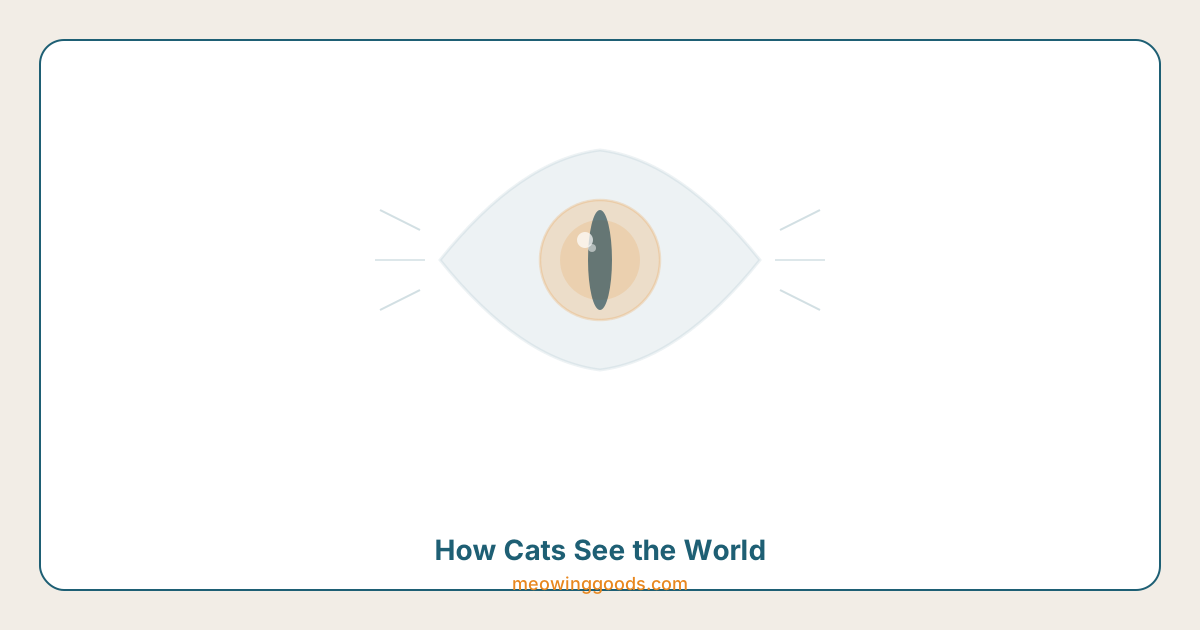
The most visually distinctive feature of a cat’s eye is its vertical slit pupil. Unlike the round pupils of humans and many other animals, cat pupils can constrict to a narrow vertical line in bright light and dilate to nearly the full diameter of the eye in darkness.
This vertical slit design serves two critical functions. First, it provides an enormous dynamic range — the ability to control the amount of light entering the eye across extreme conditions. A cat’s pupil can change its light-gathering area by a factor of approximately 135 to 300 times (compared to about 15 times for the human round pupil). This means cats can function in blinding midday sun and near-total darkness without being overwhelmed or blinded.
Second, the vertical slit interacts with the circular lens to create a multifocal optical system. When the pupil is constricted to a slit, different zones of the lens focus different wavelengths of light onto the retina simultaneously, giving the cat a form of depth perception that works even with one eye closed. This is particularly useful for judging the distance of prey before a pounce.
The Cornea and Lens: Built for Light Gathering
Relative to head and eye size, cats have a significantly larger cornea and lens than humans. The cornea (the transparent front surface of the eye) is curved more steeply, and the lens is larger in diameter. Together, these structures act like a wide-aperture camera lens, gathering more light and directing it onto the retina.
This is one reason cat eyes appear so large and prominent — the optical elements are physically bigger to maximize photon capture. In dim light, this difference is dramatic. A cat’s optical system gathers roughly six times more light than a human eye under the same conditions.
The Retina: A Rod-Dominated Landscape
The retina is where light is converted into neural signals, and it is where the most profound differences between human and cat vision reside.
Human retinas contain approximately 120 million rod photoreceptors and 6-7 million cone photoreceptors. Rods handle low-light vision and motion detection; cones handle color and fine detail. We have a dense central cluster of cones called the fovea that gives us sharp central vision for reading, recognizing faces, and seeing fine detail.
Cat retinas, by contrast, are overwhelmingly dominated by rods. Cats have roughly six to eight times more rod cells per unit area than humans. They have far fewer cones — approximately one-tenth the cone density of human retinas — and they lack a true fovea. Instead, cats have an “area centralis,” a region of somewhat higher photoreceptor density that provides the best (but still limited) detail vision.
This rod-heavy design means cats excel at detecting motion and seeing in dim light but sacrifice color richness and fine detail. A cat’s visual acuity is estimated at 20/100 to 20/200 — meaning what a human can see clearly at 100-200 feet, a cat needs to be at 20 feet to see with the same clarity.
The Tapetum Lucidum: The Biological Mirror
How It Works
Behind the retina of every cat lies the tapetum lucidum — Latin for “bright tapestry” — a layer of reflective cells that is perhaps the single most important adaptation for feline night vision. The tapetum acts as a retroreflector: light that passes through the retina without being absorbed by photoreceptors on the first pass is reflected back through the retinal cells by the tapetum, giving each photon a second chance to be detected.
This effectively doubles the amount of light available to the retina and is the primary reason cats see so well in dim conditions. It is also the reason cat eyes appear to glow when illuminated by a flashlight or car headlights at night — the tapetum is reflecting the light back out through the pupil.
The Trade-Off
The tapetum lucidum comes with a trade-off. When light bounces back through the retina, it does not return along exactly the same path it entered. The reflected photons scatter slightly, which introduces a small amount of blur into the image. This is one reason cats have lower visual acuity than humans in bright conditions — the tapetum, which is so beneficial in low light, slightly degrades image sharpness when there is already plenty of light available.
In bright light, the effect is minimal because the slit pupil constricts so tightly that very little light reaches the tapetum. But in moderate light, the scattering effect of the tapetum is part of why cat vision appears somewhat soft and dreamy compared to the sharp, high-resolution vision humans enjoy.
Eye-Shine Colors
Not all cats produce the same color of eye-shine. Most domestic cats reflect green or yellow-green light, but the exact color depends on the density and chemical composition of the tapetum cells, the age of the cat (kittens and young cats may show different eye-shine than adults), and the angle at which the light enters the eye. Blue-eyed cats, particularly Siamese, often produce a red or orange eye-shine because their tapetum has different reflective properties.
Color Vision: A Muted Palette
What Cats Actually See
Perhaps no aspect of cat vision generates more curiosity than color perception. For decades, it was widely believed that cats were completely color blind — seeing the world in shades of gray. We now know this is incorrect, but the truth is more nuanced than simply saying “cats see in color.”
Cats are dichromats. Their retinas contain two types of cone photoreceptors: one sensitive to blue wavelengths (approximately 450 nm) and one sensitive to green wavelengths (approximately 550 nm). Humans are trichromats with three cone types — blue, green, and red. Cats lack the red-sensitive cone entirely.
The practical result is that cats can distinguish between blue and green tones reasonably well, but red, orange, and pink appear as muted yellowish-brown or gray. A bright red laser dot on a beige carpet — which appears as a vivid, high-contrast target to you — appears to your cat as a slightly warm-toned moving spot against a similar-toned background. The cat chases it not because of color contrast but because of motion contrast.
Color Saturation and Brightness
Even for the colors cats can perceive, the experience is less vivid than human color vision. Cats have approximately one-tenth the cone density of humans, which means their color perception is less saturated — think of it as seeing the world through a slight gray filter. Colors are present but washed out, more pastel than vibrant.
However, cats compensate with superior brightness discrimination. Their rod-heavy retinas detect subtle differences in light and shadow that humans miss entirely. Where you see a uniformly dark corner, your cat may perceive rich gradations of shadow and subtle movements of light.
What This Means for Cat Toys
Understanding cat color vision has direct practical implications. When choosing toys, prioritize blue and yellow-green colors over red and orange — cats can see these colors more distinctly. But more importantly, prioritize motion and texture over color. A dull-colored toy that moves erratically will always be more engaging to a cat than a brightly colored toy that sits still. The Catit Senses Play Circuit works so well precisely because it creates motion that cats can track, regardless of color.
Ultraviolet Vision: Seeing the Invisible
The Discovery
One of the most remarkable recent discoveries in feline vision science came in 2014, when researchers published a study in the Proceedings of the Royal Society B demonstrating that cats — along with dogs, ferrets, hedgehogs, and many other mammals — can perceive ultraviolet light.
In humans, the lens of the eye absorbs UV wavelengths before they reach the retina. This protects our retinal cells from UV damage but means we cannot see UV-reflective patterns. Cat lenses, however, are transparent to significant portions of the UV spectrum. UV light passes through the lens and reaches the photoreceptors, where it is perceived as a visual stimulus.
What UV Vision Reveals
This UV transparency opens a hidden world of visual information. Many biological substances reflect UV light strongly:
- Rodent urine trails glow brightly under UV light. For a hunting cat, this means prey trails are literally illuminated — visible as bright, glowing paths on surfaces that appear uniform to human eyes.
- Bird feathers contain UV-reflective patterns invisible to humans but potentially visible to cats, possibly making birds easier to spot against foliage.
- Flowers display UV-reflective nectar guides that cats can perceive, though this is less relevant to their predatory lifestyle.
- Teeth and claws of other animals may have UV-reflective properties that help cats assess threats.
The ecological advantage is clear: UV vision gives cats additional visual information about their environment, particularly related to hunting and threat detection, that is completely invisible to human observers.
Why Your Cat Stares at “Nothing”
UV vision may partially explain one of the most common and unsettling cat behaviors: staring intently at a seemingly blank wall, ceiling, or empty corner. While other explanations exist (hearing sounds at frequencies beyond human perception, detecting air currents), it is entirely possible that your cat is seeing UV-reflective patterns — dust particles, insect trails, cleaning product residue — that are genuinely invisible to you.
Motion Detection: The Predator’s Edge
The Flicker-Fusion Rate
Cats are motion-detection machines. Their visual system is tuned to detect, track, and predict the movement of small, fast-moving objects — exactly the kind of visual processing a predator needs to catch mice, birds, and insects.
The key metric is the flicker-fusion rate: the frequency at which a flickering light appears to become a steady, continuous light. For humans, this rate is approximately 55-60 Hz. For cats, it is approximately 70-80 Hz. This means cats can perceive rapid changes in light and motion that appear smooth or blurred to humans.
This higher temporal resolution is why many cats seem uninterested in older television screens (which flickered at 50-60 Hz, appearing as a strobe light to cats) but are fascinated by newer screens with 120 Hz or higher refresh rates that appear smooth to feline eyes.
Motion vs. Static Vision
The rod-dominated cat retina is exquisitely sensitive to changes in light across the visual field — the neural signature of movement. A slight rustling in peripheral vision triggers immediate attention and orientation. This is the same mechanism that makes your cat’s head snap toward a fly the instant it moves, even if the cat appeared to be asleep.
However, this motion sensitivity comes at the expense of static object recognition. Cats are relatively poor at identifying motionless objects, particularly at a distance. If a mouse freezes completely, a cat may lose track of it and need to wait for movement to relocate the prey. This is why the “freeze response” evolved in many prey species — it directly exploits the predator’s motion-dependent visual system.
For cat owners, this means interactive toys that move unpredictably (darting, stopping, changing direction) engage the hunting visual system far more effectively than toys that move in smooth, predictable patterns or remain stationary.
Visual Field and Depth Perception
The Wide-Angle View
Cats have a visual field of approximately 200 degrees — about 20 degrees wider than the human visual field of 180 degrees. This wider field gives cats better peripheral awareness, which is valuable both for detecting approaching predators and for tracking prey that moves to the side.
However, not all of this visual field provides the same quality of vision. The area of binocular overlap — where both eyes see the same area and depth perception is possible — is approximately 140 degrees in cats (compared to 120 degrees in humans). This means cats actually have a larger zone of stereoscopic depth perception than humans, which makes sense for an animal that needs to judge distances accurately before pouncing.
Near-Focus Limitations
One significant limitation of cat vision is close-up focus. Cats cannot focus on objects closer than approximately 10-12 inches (25-30 cm) from their face. Below that distance, the world becomes blurry. This is why cats often sniff objects brought very close to their face rather than examining them visually — their nose takes over where their eyes leave off.
This near-focus limitation also explains why some cats seem confused by treats placed directly under their nose. They can smell the treat but cannot see it clearly enough to pick it up efficiently. Whiskers compensate for this blind zone by providing tactile information about objects close to the face.
Night Vision: Crepuscular Hunters
The Twilight Specialists
Cats are often described as nocturnal, but this is not quite accurate. Cats are crepuscular — most active during dawn and dusk, the twilight hours when light levels are transitioning between day and night. Their visual system is optimized for exactly these conditions: enough light for the rod-heavy retina and tapetum lucidum to create a detailed, high-contrast image, but too dim for most of their prey’s competitors to hunt effectively.
In these twilight conditions, a cat’s vision is at its absolute best. The combination of wide-aperture optics (large cornea and lens), high rod density, and the tapetum lucidum creates a visual system that performs superbly in the exact light levels where mice, voles, and other small prey are most active.
Comparing Cat and Human Night Vision
Under dim lighting conditions, the practical difference between cat and human vision is dramatic. In a room lit only by a single candle, a human might perceive vague shapes and shadows. A cat in the same room sees clearly enough to navigate confidently, identify objects, track moving targets, and judge distances for jumping.
The six-to-one light-gathering advantage is not the whole story, either. The cat’s brain also processes low-light visual information differently, with neural pathways optimized for extracting maximum information from minimal photon input. The result is a low-light visual experience that is qualitatively different from human vision — not just brighter, but processed with different emphasis on motion, contrast, and spatial relationships.
How Understanding Cat Vision Improves Life With Your Cat
Toy Selection
Choose toys based on motion rather than color. Wand toys with erratic, unpredictable movement patterns engage the cat’s motion-detection system more effectively than any color scheme. If you do consider color, blue and green toys provide more visual contrast for cats than red or orange ones.
Lighting Choices
Provide your cat with access to natural light during the day and avoid leaving them in complete darkness at night. While cats see well in dim light, they benefit from natural light-dark cycles for circadian rhythm health. A nightlight provides more than enough light for a cat to navigate and hunt effectively.
Environmental Enrichment
Place perches, cat trees, and observation posts near windows where changing light conditions, moving shadows, and outdoor activity provide constant visual stimulation. The combination of motion, changing light, and varying distances engages multiple aspects of the feline visual system.
Screen Time
If your cat enjoys watching screens, use devices with high refresh rates (120 Hz or above). Content featuring small, fast-moving animals (bird videos, fish swimming) on high-refresh displays creates a visual experience that cats can actually perceive and enjoy.
Understanding Behavior
Many behaviors that seem mysterious or irrational become logical when viewed through the lens of feline vision. Your cat is not being weird when they stare at a wall — they may be seeing UV-reflective patterns or detecting tiny movements invisible to you. They are not being stubborn when they ignore a motionless toy — their visual system is optimized for movement detection, not static object recognition. They are not failing to find the treat under their nose — their close-up vision is genuinely blurry.
The Evolutionary Logic
Every feature of cat vision tells an evolutionary story. The rod-heavy retina, the tapetum lucidum, the wide-aperture optics, the slit pupil, the UV transparency — each is an adaptation sculpted by millions of years of selection pressure on a small, crepuscular predator that hunts fast-moving prey in dim light.
Cats traded color richness for light sensitivity. They traded visual acuity for motion detection. They traded near-focus ability for wide-field awareness. Every trade-off was an optimization: a sacrifice of one visual capability in exchange for superior performance in the specific conditions that matter most for survival.
When you watch your cat navigate a dark room with absolute confidence, track a fly across the ceiling with laser precision, or stare with fascination at a seemingly blank wall, you are watching the product of 10 million years of visual evolution — a sensory system as different from yours as the world it reveals.
Understanding how your cat perceives the world is the first step to creating an environment that truly enriches their life. For more on feline behavior and the science behind what makes cats tick, read our guides on why cats purr and indoor enrichment ideas.
Frequently Asked Questions
Sources & References
Senior Cat Product Reviewer & Feline Nutrition Specialist
Sarah has spent over 12 years testing and reviewing cat products — from premium kibble to the latest interactive toys. She holds a certification in feline nutrition and is an associate member of the International Association of Animal Behavior Consultants (IAABC). Sarah lives in Austin, Texas, with her three cats: Biscuit (a tabby with opinions about everything), Mochi (a Siamese who demands only the best), and Clementine (a rescue who taught her the meaning of patience). When she isn't unboxing the latest cat gadget, you'll find her writing about evidence-based nutrition, helping cat parents decode ingredient labels, and campaigning for better transparency in the pet food industry.