
Why Do Cats Meow? Decoding Your Cat's Vocal Language
Learn what your cat's meows, chirps, trills, and yowls mean. Science-backed guide to feline vocal communication, from kittenhood meowing to elderly cat vocalization changes.

Senior Cat Product Reviewer & Feline Nutrition Specialist
Affiliate Disclosure: Meowing Goods is reader-supported. When you buy through links on our site, we may earn an affiliate commission at no additional cost to you. This helps us continue to provide free, expert-backed content. As an Amazon Associate we earn from qualifying purchases. Full disclosure.
Quick answer: Cats primarily meow to communicate with humans — adult cats rarely meow at each other. Each cat develops a personalized vocabulary of meows, chirps, trills, and yowls customized to their specific human. Meowing serves various purposes: greeting, hunger, attention-seeking, distress, and mating. In senior cats, changes in vocalization can indicate medical conditions including hyperthyroidism, cognitive dysfunction, and hypertension.
Meowing Goods is reader-supported. When you buy through links on our site, we may earn an affiliate commission at no extra cost to you. Learn more
Your cat walks into the kitchen and meows. You know exactly what that meow means — it’s the “I want food” meow, distinctly different from the “let me into the bedroom” meow, the “I’m happy to see you” meow, and the “something is wrong” meow. You’ve learned your cat’s vocabulary without ever consciously studying it.
This is not your imagination. Research has confirmed that cat owners can distinguish between their own cat’s different meows with significant accuracy, and that cats tailor their vocalizations to their specific humans over time. The relationship between you and your cat involves a genuine, co-created language that is unique to your pair.
The Evolution of the Meow
Here’s a fact that surprises most cat owners: meowing is almost exclusively a human-directed behavior. Adult feral cats — those who have never lived with humans — rarely meow. Kittens meow to their mothers, but they stop once weaned. In adult feral cat colonies, communication happens through body language, scent marking, hissing, growling, yowling, and caterwauling. The meow is conspicuously absent.
So where did it come from?
Over approximately 10,000 years of domestication, cats retained and refined a kitten behavior specifically because it was effective at communicating with humans. The mid-frequency meow falls squarely within the range of human hearing that we are most sensitive to — and most responsive to. It is remarkably similar in frequency to a human baby’s cry, which may not be coincidental. Cats who meowed were more successful at soliciting food, shelter, and attention from humans, and this behavioral trait was selected for over millennia.
The result is that your cat’s meow is essentially an invention of domestication — a vocalization that exists because humans respond to it.
Decoding the Meow Vocabulary
The Standard Meow
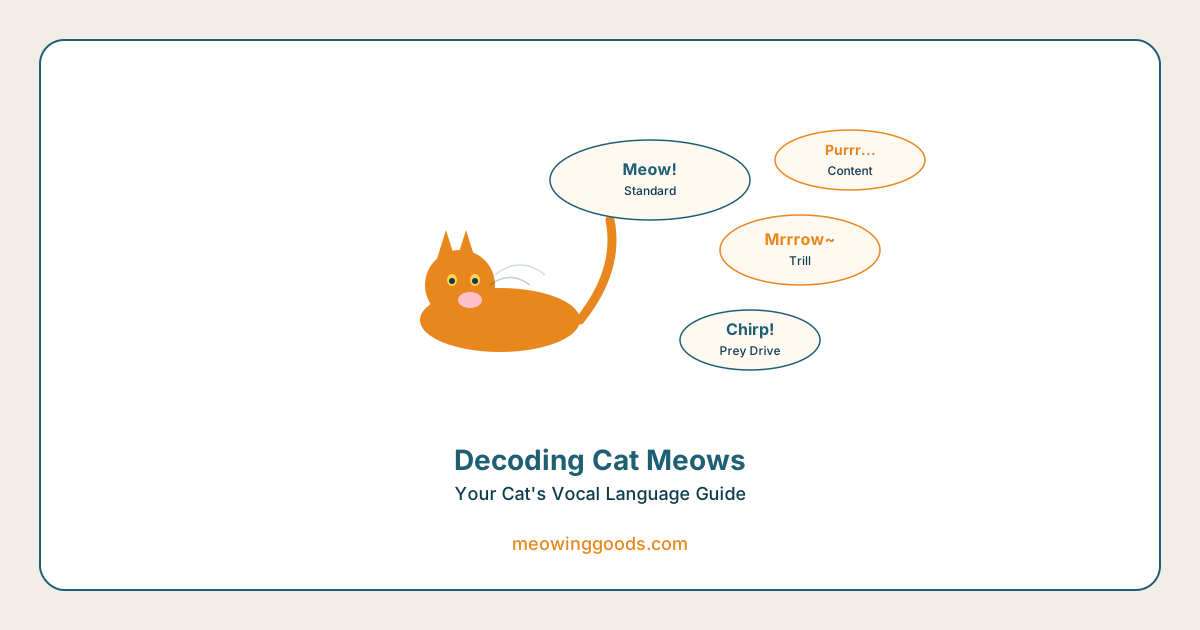
A mid-pitched, medium-length meow is the general-purpose communication tool. It means “I want your attention” without specifying what for. Context determines the meaning: a meow at the food bowl means food; a meow at the door means access; a meow when you sit down means lap time.
The Short Meow (Mew)
A brief, high-pitched “mew” is a greeting — the equivalent of “hi.” Cats who have positive associations with their humans often produce this vocalization when the person enters the room or wakes up in the morning. It’s a social acknowledgment, not a demand.
The Long, Drawn-Out Meow
A prolonged, insistent meow is a demand. The cat wants something specific and wants it now. This is the vocalization that escalates in volume and frequency if ignored. It most commonly means food but can mean door access, play, or attention.
The Low-Pitched Meow
A meow that drops to a lower register signals complaint or displeasure. You’ll hear this when you’ve done something the cat dislikes: picked them up when they didn’t want to be held, moved them off a surface, or failed to provide something they expected on schedule.
The Rapid-Fire Meow
Multiple meows in quick succession indicate excitement or urgency. Cats produce this when highly anticipating something (you’re opening a can of food) or when greeting someone after a long absence.
The Silent Meow
The cat opens their mouth in a meow shape but produces no audible sound (or a barely audible one). This is often a solicitation behavior — and it is remarkably effective because humans find it irresistibly endearing. Whether cats produce silent meows intentionally as a manipulation tactic or whether it’s a meow at a frequency below our hearing threshold is debated.
Beyond the Meow: The Full Vocal Repertoire
Purring
The low-frequency vibration (25-150 Hz) that indicates contentment, self-soothing, or healing. Cats purr when content, but also when stressed, in pain, or dying. Read our complete guide to purring for the full science.
Chirping and Chattering
The short, staccato sounds cats make while watching birds or prey through windows. Chattering — a rapid jaw movement producing a stuttering sound — is associated with predatory excitement and frustration. The exact function is debated: it may be a frustrated rehearsal of the killing bite, an attempt to mimic prey sounds, or an involuntary response to predatory arousal.
Trilling
A musical, rising-tone sound between a meow and a purr. Trilling is exclusively positive — mother cats trill to greet kittens, and adult cats trill to greet favored humans and cat companions. A cat who trills at you is expressing genuine affection and social bonding. This is one of the most reliable indicators of a happy cat-human relationship.
Hissing
A defensive vocalization that means “back off.” The hiss mimics the sound of a snake — which may be an evolved deception strategy, as snakes are dangerous to most predators. A hissing cat is frightened or feeling threatened and is warning before escalating to aggression. Never punish a hissing cat — they are communicating a legitimate boundary.
Growling
A low, rumbling vocalization indicating anger, territorial defense, or pain. A growling cat is more aggressive than a hissing cat — they are past the warning stage and may strike. Give a growling cat space immediately.
Yowling
A long, loud, drawn-out vocalization that serves multiple purposes: mating calls (intact cats), territorial announcements, distress, cognitive confusion (especially in senior cats), and illness signaling. Context matters enormously with yowling.
Caterwauling
The extremely loud, rhythmic vocalization of an intact female in heat or an intact male responding to a female in heat. This sound is designed to carry over long distances and is one of the most recognizable (and sleep-disrupting) cat vocalizations.
How Cats Customize Their Meows for You
Research from the University of Sussex published in Current Biology identified a specialized vocalization called the solicitation purr — a purr that contains an embedded high-frequency component similar to a baby’s cry. Cats use this hybrid vocalization specifically when soliciting food or attention from their humans, and it is more urgent and harder to ignore than a standard purr.
But the customization goes beyond this. Over time, cats develop specific vocalizations for specific requests, and their humans learn to decode them. A study at Lund University in Sweden found that cat owners could distinguish between their own cat’s meow meanings at rates significantly above chance — but could not distinguish the meanings of unfamiliar cats’ meows.
This means your cat has developed a vocal language specifically for communicating with you, and you have unconsciously learned it. The language is not innate — it is co-created through thousands of daily interactions over years.
When Meowing Indicates a Problem
Sudden Increase in Vocalization
If a normally quiet cat starts meowing excessively, or if a vocal cat’s meowing changes in quality, frequency, or timing, a veterinary evaluation is warranted. Medical causes include:
- Pain — especially dental pain, which is underdiagnosed in cats
- Hyperthyroidism — an overactive thyroid; one of the earliest signs is increased vocalization
- Hypertension — high blood pressure causes discomfort and restlessness
- Kidney disease — nausea and discomfort increase vocalization
- Cognitive dysfunction — feline dementia causes confusion, especially at night
- Hearing loss — deaf cats meow louder because they cannot hear their own voice
Nighttime Vocalization in Senior Cats
Any new nighttime yowling or crying in a cat over 10 should be evaluated by a veterinarian. The combination of nighttime timing and age strongly suggests one of the medical conditions listed above. Do not assume it’s “just old age” — treatable conditions like hyperthyroidism and hypertension are common culprits.
Changes in Meow Quality
A hoarse, raspy, or silent meow in a cat who was previously vocal can indicate laryngeal disease, upper respiratory infection, polyps, or — rarely — laryngeal tumors. Any persistent voice change warrants veterinary evaluation.
Living With a Vocal Cat
Some cats are simply talkative — and certain breeds are known for extensive vocal communication. Siamese, Oriental Shorthair, Burmese, and Bengal cats are among the most vocal breeds, often maintaining running conversations with their humans throughout the day.
If you have a vocal cat and it’s not medically driven:
- Respond to appropriate meowing (greetings, legitimate requests) so the cat feels heard
- Ignore demand meowing for things they don’t need right now
- Never punish vocalization — it’s their primary communication tool
- Ensure all needs are met so the cat has less reason to ask
- Enjoy it — a conversational cat is one of the more entertaining companion animal experiences
Your cat is literally talking to you. They developed this ability over thousands of years of co-evolution with humans. Whether they’re saying “feed me,” “pet me,” “I’m happy to see you,” or “something hurts” — they’re communicating, and the fact that you understand them is one of the remarkable products of the human-cat relationship.
Frequently Asked Questions
Sources & References
Senior Cat Product Reviewer & Feline Nutrition Specialist
Sarah has spent over 12 years testing and reviewing cat products — from premium kibble to the latest interactive toys. She holds a certification in feline nutrition and is an associate member of the International Association of Animal Behavior Consultants (IAABC). Sarah lives in Austin, Texas, with her three cats: Biscuit (a tabby with opinions about everything), Mochi (a Siamese who demands only the best), and Clementine (a rescue who taught her the meaning of patience). When she isn't unboxing the latest cat gadget, you'll find her writing about evidence-based nutrition, helping cat parents decode ingredient labels, and campaigning for better transparency in the pet food industry.