
Cat Weight Management: The Complete Guide to Keeping Your Cat at a Healthy Weight
Expert guide to cat weight management. Learn ideal weight ranges by breed, how to assess body condition, safe weight loss strategies, and feeding plans backed by veterinary science.

Senior Cat Product Reviewer & Feline Nutrition Specialist
Affiliate Disclosure: Meowing Goods is reader-supported. When you buy through links on our site, we may earn an affiliate commission at no additional cost to you. This helps us continue to provide free, expert-backed content. As an Amazon Associate we earn from qualifying purchases. Full disclosure.
Quick answer: Approximately 60% of domestic cats are overweight or obese, making it the most common nutritional disorder in cats. Use the Body Condition Score system (ribs palpable with light pressure, visible waist from above, slight belly tuck from the side) to assess your cat’s weight. Safe weight loss requires veterinary guidance, measured meals (not free-feeding), increased protein and fiber, interactive play, and a maximum loss rate of 1-2% body weight per week to prevent hepatic lipidosis.
Meowing Goods is reader-supported. When you buy through links on our site, we may earn an affiliate commission at no extra cost to you. Learn more
If your cat is overweight, you are not alone — and more importantly, your cat is not alone. The Association for Pet Obesity Prevention’s most recent survey found that approximately 60% of cats in the United States are classified as overweight or obese. That makes excess weight the single most common health problem in domestic cats, surpassing dental disease, kidney disease, and every other chronic condition.
The good news: feline obesity is entirely preventable and, in most cases, reversible. The approach requires understanding why cats gain weight, how to assess your cat’s condition accurately, and how to implement safe weight loss without triggering dangerous metabolic consequences.
Understanding Feline Metabolism
Cats are obligate carnivores with metabolic systems designed for high-protein, moderate-fat, low-carbohydrate diets consumed in multiple small meals throughout the day. In the wild, a cat eats 10-20 small prey items per day, each requiring the energy expenditure of stalking, chasing, and catching.
Domestic indoor cats — particularly those who are spayed/neutered and eat free-choice dry food — exist in a metabolic environment that is fundamentally mismatched with their evolutionary design. They consume calorie-dense food with zero energy expenditure required to obtain it. This mismatch is the root cause of the feline obesity epidemic.
Key Metabolic Facts
Spaying/neutering reduces metabolic rate by 25-30%. This is well-documented and is the single largest contributor to post-surgical weight gain. Cats who were lean on free-choice feeding before surgery often become overweight on the same amount of food after surgery. Caloric intake should be reduced by approximately 25% after spaying or neutering.
Cats over 7 need fewer calories. As cats age, lean muscle mass decreases and metabolic rate slows. A 10-year-old cat may need 20-30% fewer calories than the same cat at age 3.
Dry food is calorie-dense. A single cup of typical dry cat food contains 350-400 calories. An average 10-pound indoor cat needs approximately 180-200 calories per day. Free access to a bowl of kibble can easily provide double or triple the required calories.
How to Assess Your Cat’s Weight
The Body Condition Score (BCS)
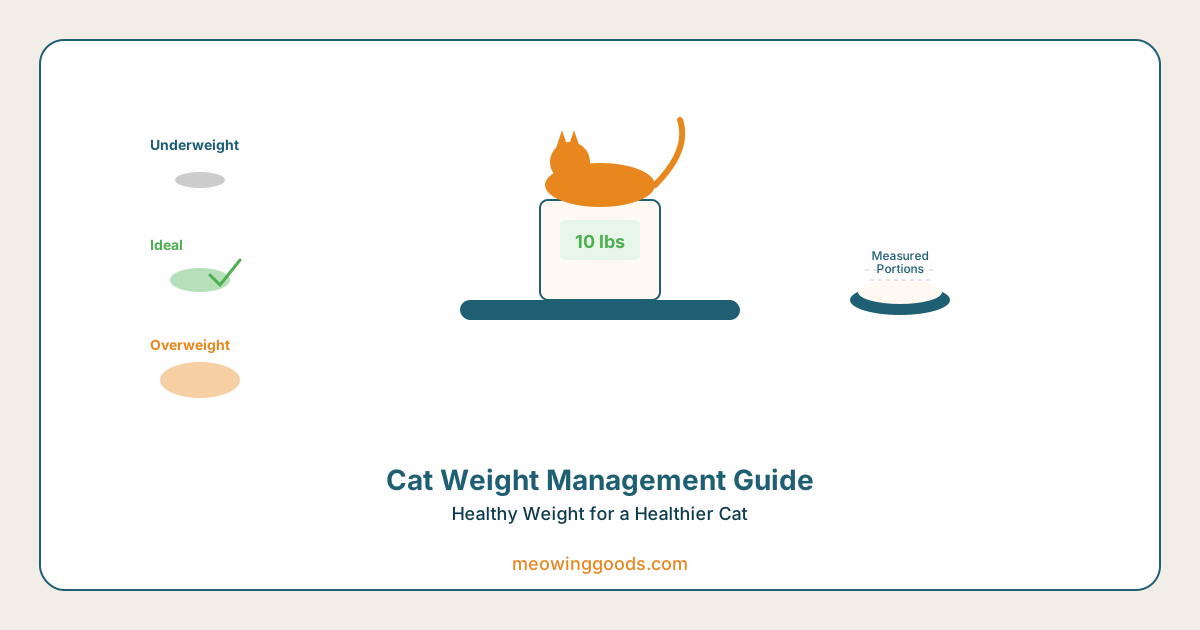
Veterinarians use a standardized Body Condition Score system to assess weight, typically on a 1-9 scale:
- 1-3 (Underweight): Ribs, spine, and hip bones easily visible. Minimal body fat. Obvious waist and abdominal tuck. This requires veterinary evaluation for underlying disease.
- 4-5 (Ideal): Ribs palpable with light pressure but not visible. Visible waist when viewed from above. Slight abdominal tuck when viewed from the side. Minimal abdominal fat pad.
- 6-7 (Overweight): Ribs difficult to feel under a layer of fat. Waist barely visible or absent. Belly may be rounded. Moderate abdominal fat pad.
- 8-9 (Obese): Ribs not palpable without firm pressure. No visible waist — barrel-shaped. Prominent belly. Large abdominal fat pad. Possible fat deposits on limbs and face.
At-Home Assessment
You can perform a basic assessment at home using three checks:
The Rib Test: Place your hands on your cat’s sides with thumbs along the spine and fingers spread along the rib cage. Apply light pressure — similar to the pressure you’d use touching your phone screen. You should feel individual ribs with this light pressure. If you need to press firmly to feel ribs, your cat is overweight.
The Overhead View: Stand directly above your cat and look down. You should see an hourglass shape — the body should narrow behind the ribs (the waist) before widening at the hips. If the body is oval or barrel-shaped with no waist indentation, your cat is overweight.
The Side Profile: Look at your cat from the side. The belly should tuck up slightly from the rib cage to the hind legs. If the belly hangs down, sways when walking, or forms a pendulous pouch, your cat is carrying excess weight. (Note: some cats, especially spayed females, develop a normal primordial pouch — a loose skin flap on the lower belly. This is not the same as fat. A primordial pouch feels like loose skin; excess fat feels firm and padded.)
Ideal Weight Ranges by Breed
While individual cats vary, these are general guidelines:
| Breed | Ideal Weight Range |
|---|---|
| Siamese / Oriental | 6-10 lbs |
| Domestic Shorthair (average) | 8-11 lbs |
| Persian / Exotic | 7-12 lbs |
| British Shorthair | 9-17 lbs |
| Maine Coon | 12-18 lbs (males), 8-12 lbs (females) |
| Bengal | 8-15 lbs |
| Ragdoll | 10-20 lbs |
| Russian Blue | 7-12 lbs |
These are ranges, not targets. Your veterinarian can determine your individual cat’s ideal weight based on their frame size and body composition.
Why Feline Obesity Is Dangerous
Excess weight in cats is not cosmetic — it drives serious, life-shortening medical conditions:
Diabetes Mellitus
Obese cats are 3-5 times more likely to develop Type 2 diabetes than lean cats. The mechanism is the same as in humans: excess body fat creates insulin resistance, forcing the pancreas to produce more insulin until it can no longer keep up. The remarkable aspect of feline diabetes is that it can sometimes be reversed entirely — when an overweight diabetic cat achieves a healthy weight through diet and exercise, insulin sensitivity may return to normal, eliminating the need for insulin injections. This is called diabetic remission and is a powerful motivator for weight management.
Osteoarthritis
Every excess pound your cat carries increases the mechanical stress on joints. A study published in the Journal of Feline Medicine and Surgery found that overweight cats show significantly more signs of chronic pain and reduced mobility than lean cats. Arthritis creates a vicious cycle: pain reduces activity, reduced activity promotes weight gain, and increased weight worsens joint pain.
Hepatic Lipidosis
This is the most immediate danger of weight in cats — not from the weight itself, but from what happens when an overweight cat stops eating. Hepatic lipidosis (fatty liver disease) occurs when a cat’s body rapidly mobilizes stored fat for energy, overwhelming the liver’s ability to process it. Fat accumulates in liver cells, impairing liver function and potentially causing liver failure. Obese cats who stop eating for as few as 48-72 hours are at risk. This is why crash diets and sudden food changes are dangerous for overweight cats — and why veterinary supervision during weight loss is essential.
Urinary Tract Disease
Overweight cats have higher rates of feline lower urinary tract disease (FLUTD), including life-threatening urinary blockages in male cats. The association may be related to reduced water intake, reduced physical activity, and stress.
Reduced Grooming Ability
Obese cats physically cannot reach certain areas of their body to groom. The most common area is the hindquarters and lower back. This leads to matting, skin infections, fecal soiling, and urine scalding — conditions that cause significant discomfort and often require veterinary treatment.
Safe Weight Loss Strategies
Rule #1: Consult Your Veterinarian First
Before changing your cat’s diet, schedule a veterinary visit. Your vet will:
- Confirm your cat’s actual weight and Body Condition Score
- Rule out medical causes of weight gain (hypothyroidism is rare in cats but possible)
- Set a realistic target weight
- Calculate appropriate daily caloric intake
- Recommend a specific food and feeding plan
- Schedule follow-up weigh-ins (typically monthly)
Rule #2: Never Fast a Cat
This cannot be overstated. Cats cannot safely go without food for more than 24-48 hours. Hepatic lipidosis is a medical emergency, and overweight cats are at highest risk. Even during a weight loss program, your cat must eat every single day.
Rule #3: Lose Weight Slowly
The safe maximum rate of weight loss for cats is 1-2% of body weight per week. For a 15-pound cat, that’s 0.15-0.30 pounds per week. At this rate, reaching an ideal weight of 11 pounds takes approximately 3-6 months. This feels slow, but faster weight loss risks hepatic lipidosis.
Feeding Strategy
Switch from free-feeding to measured meals. This is the single most impactful change. Feed two to three measured meals per day using a kitchen scale (not a measuring cup — volume is imprecise for calorie counting).
Calculate calories, not volume. Check the caloric content on your cat’s food packaging (kcal per cup or per can). Measure food to provide the calorie target your vet recommends — typically the resting energy requirement (RER) for the target weight, calculated as 70 × (target weight in kg)^0.75.
Increase protein, increase fiber. High-protein diets preserve lean muscle during weight loss. High-fiber diets promote satiety — your cat feels full on fewer calories. Veterinary weight management diets like Blue Buffalo Tastefuls Indoor are formulated with this balance.
Consider wet food. Canned food is approximately 75-80% water, meaning a can of food is less calorically dense per gram than the same weight of kibble. Cats on wet food diets tend to consume fewer total calories while feeling more satisfied.
Exercise and Enrichment
Indoor cats need active play to burn calories and maintain muscle mass. Aim for at least two 15-minute interactive play sessions daily using wand toys, feather teasers, or laser pointers.
Puzzle feeders like the Catit Senses Digger slow eating, provide mental stimulation, and require physical effort to access food — mimicking the natural hunting effort that wild cats expend for every meal.
Vertical spaces encourage climbing and jumping, which burns more calories than walking. Cat trees, wall shelves, and elevated perches transform floor space into three-dimensional exercise territory.
Monitoring Progress
Weigh your cat weekly on a consistent scale, at the same time of day. A baby scale or a bathroom scale (weigh yourself holding the cat, then subtract your weight) works for home monitoring. Record weights in a log or app.
Expected progress: 0.15-0.30 lbs per week for a 15-pound cat. If your cat isn’t losing weight after 4 weeks of the prescribed diet, consult your vet — the caloric target may need adjustment.
Plateau management: Weight loss often stalls at 80-90% of the way to the target weight. This is normal. Your vet may need to recalculate the caloric target based on the cat’s new lower weight.
Maintaining a Healthy Weight
Once your cat reaches the target weight, the work isn’t over — maintenance requires the same measured feeding approach that achieved the weight loss. The caloric intake can increase slightly (to maintenance level rather than weight loss level), but returning to free-feeding will likely restore the weight.
Continue daily play sessions, puzzle feeders, and regular weigh-ins (monthly is sufficient once weight stabilizes). Annual Body Condition Score assessments at veterinary checkups help catch gradual weight creep before it becomes significant.
Recommended Products for Weight Management
- Blue Buffalo Tastefuls Indoor — Calorie-controlled indoor cat formula with hairball fiber
- Purina Pro Plan Indoor — Veterinarian-recommended indoor formula with probiotics
- Catit Senses Digger — Puzzle feeder that slows eating and adds hunting enrichment
- PetSafe Drinkwell Fountain — Encourages water intake for cats transitioning to wet food
Frequently Asked Questions
Sources & References
Senior Cat Product Reviewer & Feline Nutrition Specialist
Sarah has spent over 12 years testing and reviewing cat products — from premium kibble to the latest interactive toys. She holds a certification in feline nutrition and is an associate member of the International Association of Animal Behavior Consultants (IAABC). Sarah lives in Austin, Texas, with her three cats: Biscuit (a tabby with opinions about everything), Mochi (a Siamese who demands only the best), and Clementine (a rescue who taught her the meaning of patience). When she isn't unboxing the latest cat gadget, you'll find her writing about evidence-based nutrition, helping cat parents decode ingredient labels, and campaigning for better transparency in the pet food industry.